Plantar Warts: Why Six Weeks of Drugstore Treatment Didn't Work
Why freeze kits and salicylic patches so often fail on warts on the soles of the feet, what actually makes plantar warts different, and when to stop trying at home.
You bought the freeze kit. You used it on the label’s schedule. Then you switched to the medicated patches and stuck with those for a month and a half, filing it back in the shower like the box said.
It is still there. It might even be bigger, and now there are two.
This is the single most common story we hear from people who come to us for wart removal, and the reason is not that you did it wrong. It is that a wart on the sole of your foot is a genuinely different problem from a wart on your finger, and most products on the shelf are built for the finger.
Plantar warts grow the wrong way
Everywhere else on the body, a wart grows outward. You can see the whole thing.
On the sole of your foot, your body weight is pressing down on it every time you stand. So it grows inward, flattening out and pushing deeper into skin that is already the thickest on your body. What you see on the surface can be a small window onto something considerably larger underneath.
Two consequences follow directly:
- Surface treatments are working at the wrong depth. They are applied to the top of a lesion whose active part is below.
- It hurts in a specific way. A plantar wart often feels like walking on a small stone, and the pain comes from pressure on the deeper part rather than from the surface.
There is also the classic tell: plantar warts frequently interrupt the natural lines of the skin on your sole, and often show tiny dark dots — clotted capillaries — inside them.
Why the drugstore aisle underdelivers here
Not because the products are fake. Because of what they can reach.
Freeze kits. The home versions do not get as cold, or reach as deep, as the clinical equivalent. On thin skin over a knuckle, that can be enough. Through the sole of a foot, usually not.
Salicylic acid patches and paints. These genuinely work for a lot of people, but they demand real consistency: daily application for many weeks, plus filing back the softened dead layer so the next application reaches live tissue. Most people stop somewhere in week three, which is a reasonable human response to a boring routine and also why it failed.
Duct tape and home remedies. There is a small amount of evidence and a very large amount of internet enthusiasm. It is not dangerous. It is also not why we are writing this.
Cutting or burning it yourself. Don’t. The foot is a poor place to create an open wound, it is constantly under pressure and in a shoe, and warts spread through contact — including to the fresh skin you just injured.
The part nobody puts on the box: it’s a virus
Warts are caused by human papillomavirus, and every frustrating thing about them follows from that.
It explains why they spread — to the other foot, to your hands from touching them, to other people through damp shared floors. It explains why they can come back in the same place after apparently successful treatment. And it explains why some people clear them in months without doing anything while others fight the same wart for two years: the difference is largely immune response, not effort.
It also means removal is honest about its scope. Treating a wart addresses that lesion. It does not make you immune, and it cannot promise that no new ones appear. Anyone who tells you otherwise is selling.
When to stop trying at home and see a doctor — not us
Some feet need a physician, and this is where we say so.
Go to a doctor or a foot specialist first if:
- You have diabetes, reduced circulation, or reduced sensation in your feet. Foot lesions in that context are a medical matter, full stop.
- It is bleeding on its own, changing colour or shape, or growing quickly.
- It is painful enough to change how you walk.
- You are not certain it is a wart. Corns, calluses and other growths can look similar, and Vicaria does not diagnose skin conditions. Vicaria’s practitioners are not licensed physicians or dermatologists in Ontario.
That list is not us being cautious for form’s sake. A foot that has lost sensation and a growth that might not be a wart are exactly the combination where a cosmetic appointment is the wrong first step.
What we do, for the cases that suit it
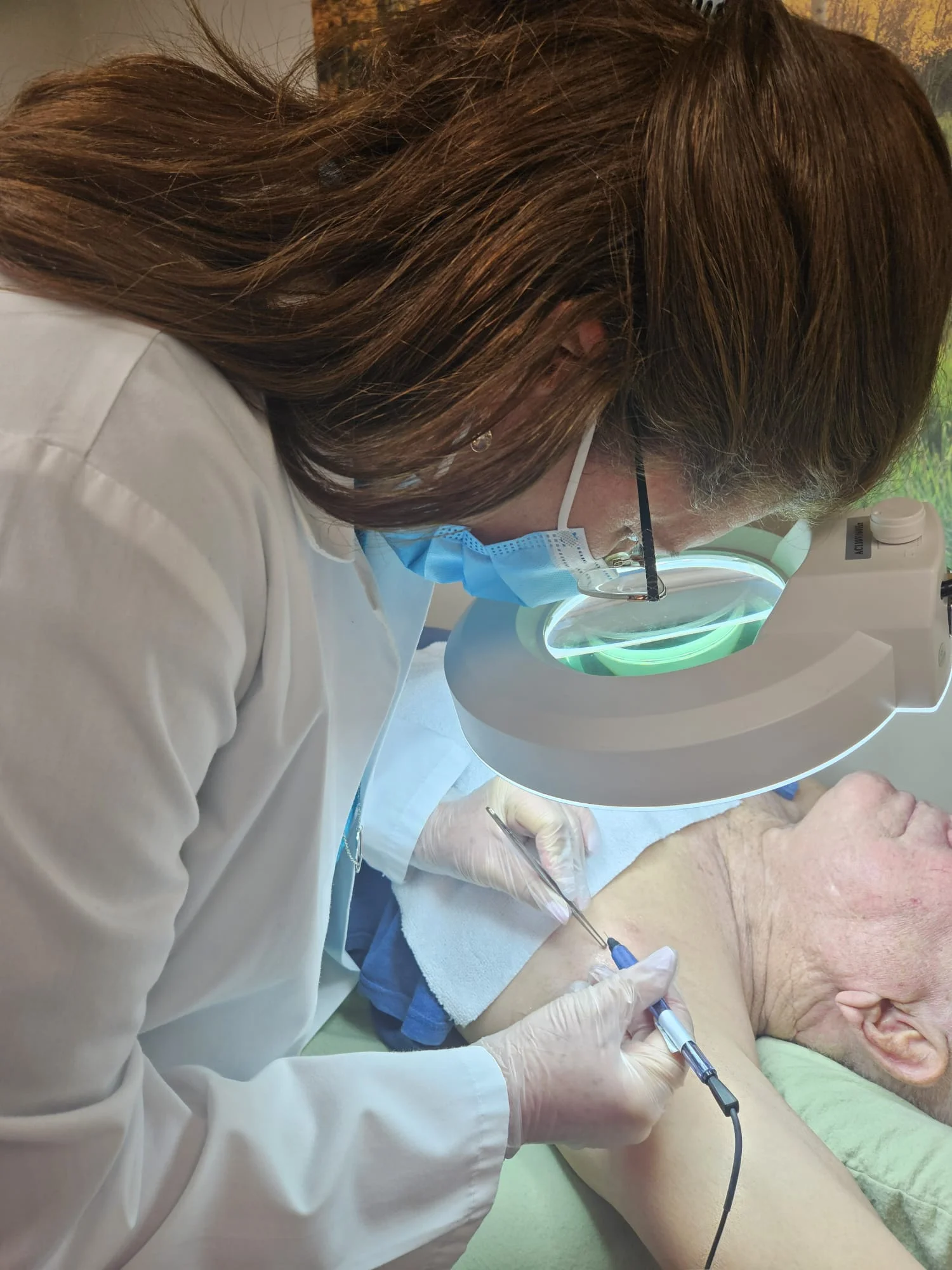
For a familiar wart in a suitable location, we use electrocautery — controlled heat applied to a small treatment area. It works at depth rather than on the surface, which is precisely the gap the drugstore aisle leaves.
We review the location, the number, how long it has been there and what you have already tried, and we tell you whether it looks like a straightforward cosmetic case. Appointment length depends on size and location. Expect temporary redness, a scab that resolves on its own, written aftercare, and honesty about the fact that healing on a weight-bearing surface takes a bit more care than healing on a forearm.
Pricing is the same as everything else we treat: free 15-minute phone or WhatsApp consultation, $60 + tax for the in-person consultation, from $20 + tax per lesion. The full cost and OHIP guide is here, and the wart removal service page is here.
Booking in Hamilton
Vicaria offers wart removal in Hamilton at Unit 2B, 144 James St S, downtown, and we see clients from Ancaster, Dundas, Stoney Creek, Waterdown, Burlington and Grimsby.
Start with the free 15-minute call. Tell us where it is, how long you have had it, what you have already tried, and whether you have any circulation or sensation issues in your feet. That last question is the one that decides whether you should be talking to us at all.
Call (365) 336-9757 or message us on WhatsApp.
Important: if you have diabetes, poor circulation or reduced feeling in your feet, or if a growth is painful, bleeding, dark, irregular or changing, see a licensed physician before booking any cosmetic removal.
Services that fit this topic
Frequently Asked Questions
Why didn't the freeze kit work on my foot?
Two reasons. The skin on the sole is far thicker than anywhere else on the body, so it soaks up most of the effect before it reaches the wart. And plantar warts grow downward under pressure, so the part you can see is often the smallest part of the problem. Home kits are designed for shallow warts on thin skin.
How long should I try over-the-counter treatment before giving up?
Salicylic acid preparations genuinely do work for many people, but they need consistent daily use over weeks, including filing back the dead layer. If you have been diligent for six to twelve weeks with no change at all, more of the same is unlikely to be the answer.
Are plantar warts contagious?
Yes. Warts are caused by human papillomavirus and spread through contact and shared damp surfaces — pool decks, changing rooms, shared showers, bathroom floors at home. This is also why they turn up on the other foot, and why household members can pick them up.
Is a painful lump on my sole definitely a wart?
No, and this one matters. Corns, calluses and other growths can look and feel similar, and a few things that are not warts at all can appear on the foot. Vicaria does not diagnose skin conditions. If you have diabetes, reduced circulation or reduced sensation in your feet, see a physician or a foot specialist rather than any cosmetic clinic.
Will it come back after removal?
It can. The virus is the reason: removing the growth deals with the lesion, not with your exposure or immunity. Recurrence in the same area or elsewhere is possible, and no cosmetic procedure can promise otherwise. We tell people this before treatment rather than after.
Yamilet Pina and Maurin Casella are certified health coaches (IIN). This content is educational and does not replace medical advice. If you have a medical condition, please consult your healthcare provider.