Sebaceous Hyperplasia: Why Your Acne Routine Made Those Bumps Worse
Why sebaceous hyperplasia is mistaken for acne and milia, why retinoids and salicylic acid don't clear it, and what electrocautery treatment actually involves.
You have been treating these as acne for two years.
Salicylic acid, then retinol, then a stronger retinol. Maybe a clay mask twice a week. The bumps on your nose and forehead are exactly where they were, and now the skin around them is red and tight.
This is the most common story we hear from people who come to us for sebaceous hyperplasia treatment, and it is not a skincare failure. It is a category error — and an easy one, because these bumps look enough like blocked pores that treating them that way is entirely reasonable until someone tells you otherwise.
It is an enlarged gland, not a blocked pore
Your skin is full of sebaceous glands that produce oil. Sebaceous hyperplasia is one of those glands that has simply grown larger than the others.
That is the whole condition. Nothing is blocked. Nothing is infected. There is nothing inside to extract.
Which explains, in one step, why every product aimed at acne does nothing:
- Salicylic acid clears pore contents. There are no pore contents here.
- Retinoids speed up turnover and can prevent some blockages. They do not shrink a gland.
- Benzoyl peroxide is antibacterial. There is no bacterial component.
- Extraction tools need something to come out. Nothing does, and pressing hard enough to try leaves a bruise.
- Clay masks and scrubs work on the surface. The gland is below it.
What all of them do achieve is irritation. Which is why so many people arrive convinced their skin got worse: it did, but not in the way they think. The bumps were static. The redness around them was new.
How to spot it
The features that separate it from the things it gets confused with:
- Soft, not firm. Milia feel like tiny hard beads. These give slightly.
- Skin-coloured or faintly yellow, rather than white.
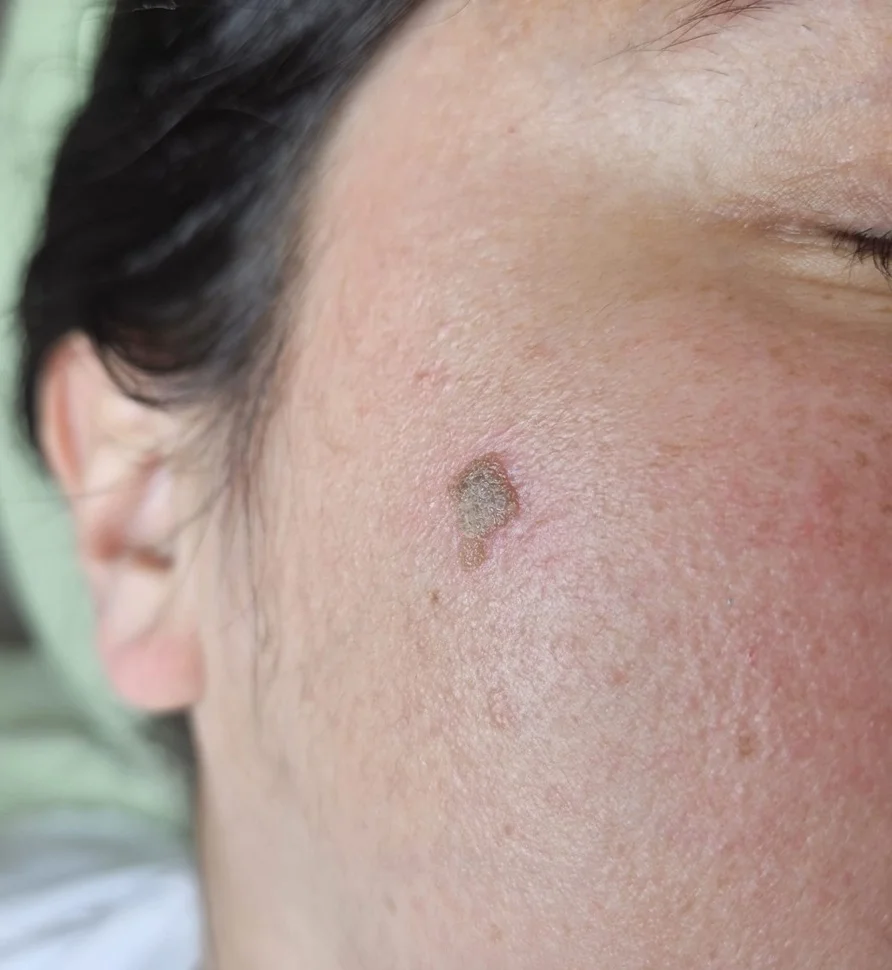
- A small dimple or crater in the centre. This is the most useful single tell.
- Fine visible vessels around the rim on some of them.
- 1–3mm, and stable. It has looked the same for a year or more. Spots do not do that.
- Location: forehead, nose, cheeks, and the T-zone generally. Occasionally the chest.
And what it is not:
- Acne — inflamed, changes over days, often tender.
- Milia — firm, white, extracts as a pearl.
- Cherry angioma — red, made of vessels.
- Seborrheic keratosis — waxy, brown, looks stuck on.
There is one thing on this list that matters more than the rest. Some skin cancers, particularly basal cell carcinoma, can resemble a small benign facial bump — and the nose is a common location for both. Vicaria does not diagnose skin conditions. If a bump is new, growing, bleeding, crusting, ulcerated, or simply unlike your other bumps, that is a physician’s appointment before it is a cosmetic one. We say the same thing on the service page, and we mean it as a routing instruction rather than a disclaimer.
Why it happens
Less dramatic than the internet suggests:
- Age. It becomes common from the late thirties onward.
- Genetics. The strongest factor after age.
- Not simply “oily skin”. The association with how oily your skin feels is weaker than people assume, and plenty of people with dry skin have them.
- Long-term ciclosporin is a recognised association. If you take it, mention the bumps to your prescriber rather than to us.
Nothing here is a sign that you have done something wrong to your face.
What treatment involves
For a familiar, stable bump in a suitable location, we use electrocautery — controlled heat applied to a very small area, which reduces the enlarged gland rather than trying to empty it.
It is quick, usually seconds per bump, and most people describe a brief warm pinch. Several bumps are typically handled in one appointment. The face means we work carefully and in smaller batches than we would on a back.
Afterwards: a small scab is normal and resolves on its own, and you leave with written aftercare. Healing time and cosmetic results vary, and scarring, pigment change, bleeding and infection are all possible — we go through that before you agree to anything.
And the honest limit: these can recur in the same area. The gland is a normal structure that grew, and biology does not sign a contract afterwards. Most people find that acceptable when it is said upfront.
Cost
- Free 15-minute phone or WhatsApp consultation
- In-person consultation: $60 CAD + tax
- Treatment: from $20 CAD + tax per lesion, by size and location
The consultation fee is charged once, not per bump. For the wider picture on pricing and why OHIP generally does not cover cosmetic removal, see the cost and coverage guide.
Booking in Hamilton
Vicaria is at Unit 2B, 144 James St S in downtown Hamilton, serving Ancaster, Dundas, Stoney Creek, Waterdown, Burlington and Grimsby.
If you have been treating these as acne, bring that history to the call. What you have already tried, and for how long, tells us a lot — including, sometimes, that you should be seeing a doctor rather than us.
Call (365) 336-9757 or message us on WhatsApp.
Important: a facial bump that is new, growing, bleeding, crusting or unlike your other spots should be assessed by a licensed physician or dermatologist before any cosmetic treatment.
Services that fit this topic
Frequently Asked Questions
What is the difference between sebaceous hyperplasia and acne?
Acne involves a blocked pore, inflammation and often a visible plug or pus. Sebaceous hyperplasia is an oil gland that has simply grown larger — no blockage, no infection, nothing to extract. It sits there unchanged for years, which is the opposite of how a spot behaves.
How is it different from milia?
Milia are firm white keratin cysts sitting just under the surface, and they extract cleanly as a small pearl. Sebaceous hyperplasia bumps are softer, skin-coloured to yellowish, usually with a central dimple, and there is nothing inside to lift out. They need a different treatment entirely.
Will retinol or salicylic acid clear it?
Generally no. Both work on cell turnover and pore contents, and neither shrinks an enlarged gland. Many people find the area looks worse on an aggressive routine, because they add irritation and redness to a bump that has not changed. If your routine has not touched them in three months, more of it is unlikely to help.
Does it mean my skin is too oily?
Not reliably. It is more strongly associated with age and with genetics than with how oily your skin feels day to day, and it turns up on people with dry skin as well. Long-term ciclosporin use is a recognised association worth mentioning to your doctor if it applies to you.
Will they come back after treatment?
They can. The gland is a normal structure that has enlarged, and recurrence in the same area over time is possible. Healing and recurrence vary from person to person, and no cosmetic procedure can guarantee that future bumps will not appear.
Can you tell it apart from something more serious?
We do not diagnose skin conditions — our practitioners are not licensed physicians or dermatologists in Ontario. Some skin cancers can resemble a benign facial bump, particularly on a nose. If a bump is new, growing, bleeding, ulcerated, or does not look like your other spots, see a physician before booking any cosmetic treatment.
Yamilet Pina and Maurin Casella are certified health coaches (IIN). This content is educational and does not replace medical advice. If you have a medical condition, please consult your healthcare provider.