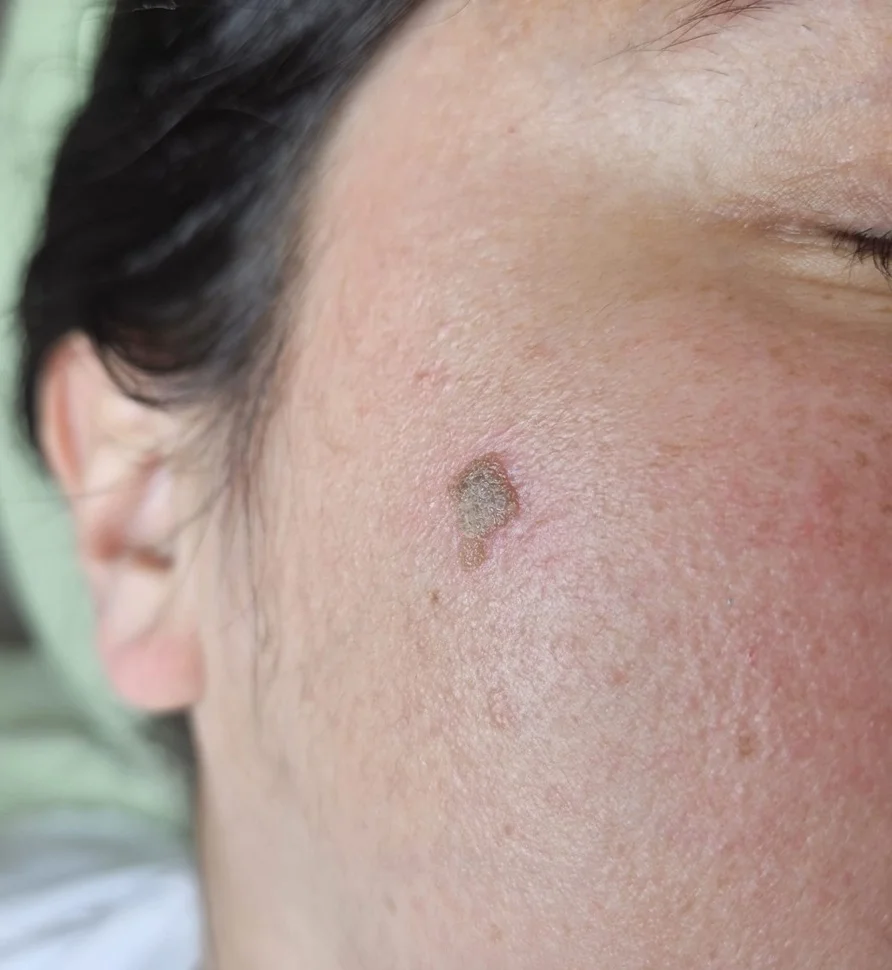
A Skin Tag on Your Eyelid: Read This Before You Book Anyone
Why the eyelid is the one place cosmetic clinics should be cautious about, what a skin tag near the eye can be confused with, and who should actually treat it.
Of everything we get asked about, a bump on the eyelid is the one where the most useful thing we can say is be careful who you let touch that.
Including us. Especially us, in some cases. We offer cosmetic skin tag removal in Hamilton, and the eyelid is the one place where the honest answer is sometimes “not here”.
This is the highest-volume search in our whole area of work, which tells you how many people are sitting at home right now looking at something small on their eyelid and wondering what to do about it. So here is the version written by a clinic that is willing to lose the booking.
Why the eyelid is different
Every other place a skin tag grows, the worst realistic outcome of a bad removal is a scar. On the eyelid, the structures you are millimetres away from are the ones you see with.
Three things make it a different job:
- The skin is the thinnest on the body. There is very little margin between the surface and what is underneath.
- The eye itself is right there. Anything applied to eyelid skin — heat, acid, cold, a blade — is one slip from the cornea.
- Eyelids move constantly. Blinking means the treated area is never still, which changes how it heals.
That is why the eyelid appears in the cautions of essentially every at-home removal product, in the manufacturer’s own words. It is not marketing conservatism. It is the one place where a cosmetic mistake becomes a medical emergency.
Never do this one at home
We say this on every page, but here it is without hedging: do not tie, cut, freeze or acid-treat anything on your eyelid.
Home removal bands cut off blood supply, and you cannot control what else they compress. Freezing kits do not aim. Salicylic and other acid preparations do not stay where you put them, especially on skin that folds and blinks. And a tag that bleeds on an eyelid is far harder to manage than one on your neck.
If you take one thing from this page, take that one.
What that bump might actually be
Several distinct things appear on eyelids and look broadly similar to a non-specialist. They need different treatments, and two of them are infections.
- Skin tag — a soft flesh-coloured flap on a narrow stalk. Hangs off the skin.
- Milia — firm white or pearly keratin cysts sitting just under the surface. Extremely common around the eyes, and they do not respond to skincare.
- Xanthelasma — flat or slightly raised yellowish patches, usually on the inner corners of the lids. These are cholesterol deposits, and they are worth mentioning to your family doctor for reasons beyond appearance.
- A stye — tender, red, often swollen, near the lash line. An infection.
- A chalazion — a firmer, usually painless lump from a blocked oil gland. Often needs medical management.
Vicaria does not diagnose skin conditions. A webpage certainly cannot. If you are reading that list and genuinely unsure which describes yours, that uncertainty is itself the answer: start with a physician.
Where our line actually is
We would rather be specific than vague, because “we’ll take a look” is how people end up in the wrong chair.
We may be able to help when a familiar, long-standing skin tag sits on the outer eyelid skin, clearly away from the lash line, and you are not uncertain about what it is.
We will send you elsewhere when the lesion is on or near the eyelid margin, on the inner surface of the lid, close to the tear duct, tender or infected-looking, changing, dark, irregular, or when the description on the phone leaves any real doubt. Depending on the location, that referral is to a licensed physician, a dermatologist, or an eye-care professional.
Vicaria’s practitioners are not licensed physicians or dermatologists in Ontario. In most parts of the body that boundary is a formality you never notice. On an eyelid it is the whole point.
The free call is the useful step here
For this one specifically, start with the free 15-minute phone or WhatsApp consultation rather than booking anything.
Describe where it sits relative to your lashes, how long it has been there, whether it has changed, and whether it is tender. In a lot of eyelid cases that conversation ends with us telling you to see your doctor — and that has saved you the $60 in-person consultation fee and pointed you at the right person.
If it turns out to be suitable and away from the margin, our normal skin tag removal pricing in Hamilton applies: from $20 + tax per lesion after the in-person consultation. You can see the full cost and OHIP picture here.
Call (365) 336-9757 or message us on WhatsApp. We are at Unit 2B, 144 James St S in downtown Hamilton.
Important: for anything on or near the eye that is changing, painful, bleeding, dark, irregular or affecting your vision, see a licensed physician or eye-care professional. Do not start with a cosmetic clinic, ours included.
Services that fit this topic
Frequently Asked Questions
Can you remove a skin tag on the eyelid?
Sometimes, depending on exactly where it sits. A tag on the outer eyelid skin, away from the lash line, may be suitable for cosmetic treatment. Anything on or near the eyelid margin, on the inner surface, or close to the tear duct is not something we take on — we direct those to a licensed physician or eye-care professional.
Is it safe to use a skin tag removal kit near my eye?
No. Freezing kits, acids and removal bands carry warnings against use near the eyes for good reason, and those warnings are the manufacturer's own. Chemical or freezing injury to the cornea is not a cosmetic problem, it is an eye injury. This is the single clearest case for not doing it yourself.
How do I know if it's a skin tag or something else?
You often can't, and neither can a photo. Milia are firm white cysts under the surface, xanthelasma is a flat yellowish cholesterol deposit, a stye is a tender infection near the lash line, and a chalazion is a firmer blocked gland. They can look similar to a non-specialist. Vicaria does not diagnose skin conditions, which is exactly why an uncertain lump near the eye starts with a doctor.
Will it damage my vision if I leave it alone?
A small lesion on the outer eyelid skin usually does not affect vision, but anything that touches the eye surface, rubs the cornea, weighs on the lid, or blocks part of your field of view needs medical assessment rather than patience. If it is interfering with your eye at all, that is a doctor's appointment.
What does the free consultation tell me if you can't treat it?
It tells you what to do next and saves you a $60 in-person consultation fee. We will describe what the options generally are and who is the right person to see. Being told 'not us, see your doctor' in a 15-minute free call is a good outcome.
Yamilet Pina and Maurin Casella are certified health coaches (IIN). This content is educational and does not replace medical advice. If you have a medical condition, please consult your healthcare provider.