What Causes Cherry Angiomas — And Why You Suddenly Have Nine of Them
Why cherry angiomas appear after 30, why they multiply, why they bleed so much for their size, and what actually removes the small red dots on your chest and arms.
The moment that brings people in is rarely the first one.
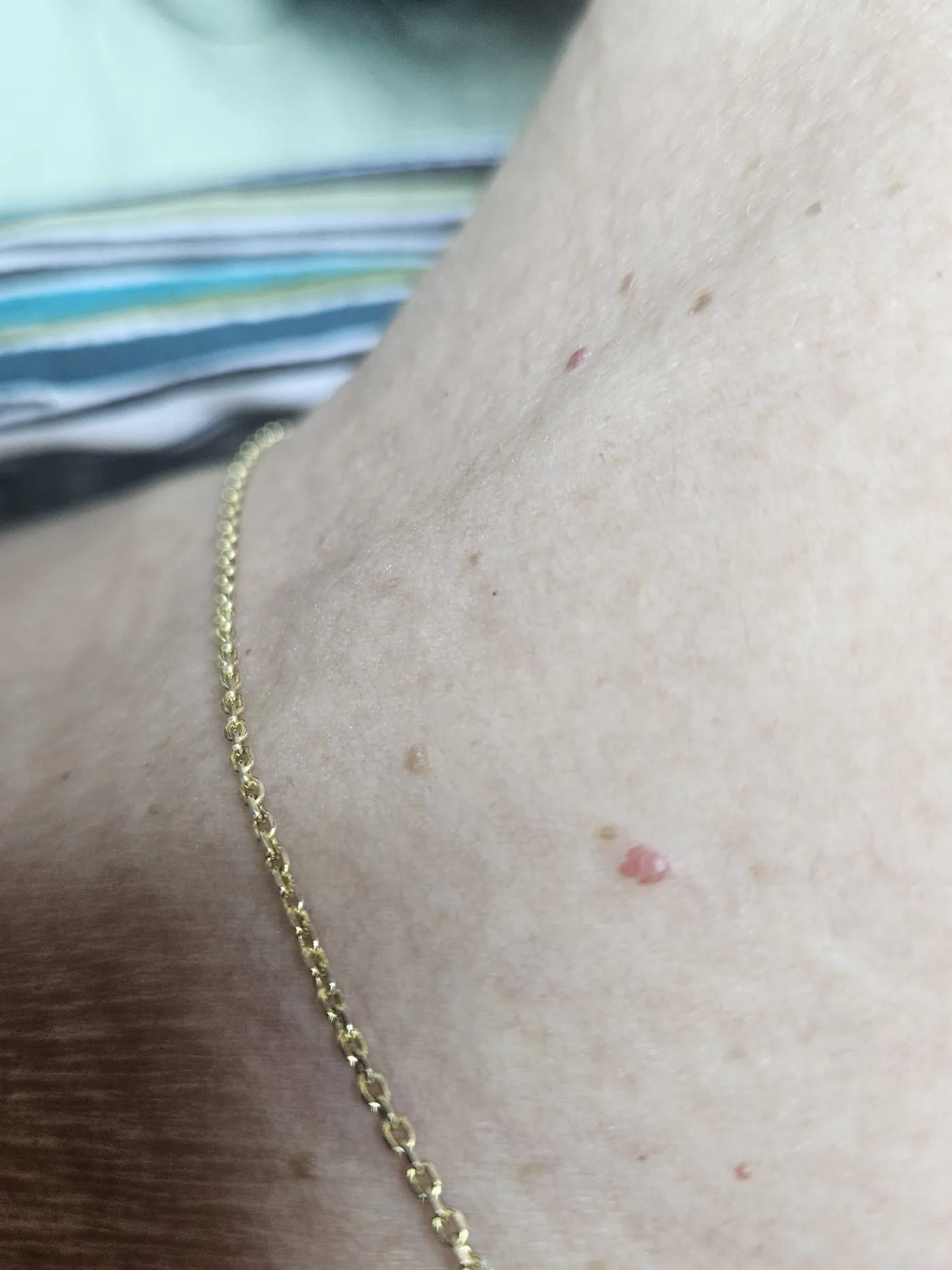
It is the count. You had one on your chest for years and thought nothing of it. Then you are getting changed one evening and you notice there are four. And now that you are looking, two on your upper arm and one on your back.
Nothing has gone wrong. But the arithmetic is unnerving, and nobody explains it to you, so here is the explanation, and what cherry angioma removal does and does not change.
What they actually are
A cherry angioma — also called a ruby point, a red mole, or by its formal name, a haemangioma of the skin — is a small, benign proliferation of blood vessels just under the surface.
That single fact explains almost everything people find odd about them:
- They are bright red because they are full of blood, not pigment. That is why they look different from a mole.
- They do not fade the way a bruise or a burst capillary does. The vessels are structural, not an event.
- They bleed remarkably for their size when caught, because you have nicked a vessel bundle rather than scratched skin.
- They are slightly raised and dome-shaped in most cases, though flat ones are common too, particularly early on.
They are typically 1–4mm. Larger ones exist. They turn up most on the chest and torso, then the arms and shoulders, the back, the face and neck, the scalp and the legs.
Why they arrive when they do
Here is where I want to be careful, because this topic attracts confident explanations that the evidence does not support.
Well established:
- Age. Uncommon before 30, unremarkable after 40, and the number tends to increase with each decade. This is the single strongest pattern.
- Genetics. They run in families. If your parent had a chest full of them, that is the best available predictor.
- Pregnancy. A recognised trigger, and some of the ones that appear then do fade afterwards.
Not established, despite what you will read:
- Sun exposure. These are not sun-damage lesions. They appear on skin that never sees daylight.
- Diet, “toxins”, liver function, bromine. There are corners of the internet with elaborate theories here. They are not supported.
- A single lesion “spreading”. It does not work like that. The tendency is systemic — you form them, so more form. One spot is not infecting the next.
There are rare situations where a sudden crop of many angiomas is worth mentioning to a doctor, alongside anything else that has changed in your health. That is a reasonable thing to raise at your next appointment. It is not a reason for alarm, and it is not something we can assess.
Why they multiply — and what that means for treatment
This matters more than it sounds, because it changes what removal can honestly promise.
The spots we treat are dealt with in the session. What we cannot do is change the fact that you are someone who forms them. New ones can still appear elsewhere over time, and no cosmetic procedure can promise otherwise.
Most people are entirely fine with that once it is said out loud. They came in with nine, they leave with none, and if three more show up in two years those are a short appointment. What causes trouble is a clinic that implies otherwise and a client who feels misled two years later.
The bleeding is the real reason most people book
Appearance gets people looking. Bleeding gets them booking.
Because these are vessel clusters, a knock that would do nothing to normal skin can start a surprisingly persistent bleed. Towels after a shower, a fingernail, a bra underwire, a razor across the chest, a comb on the scalp. It stops with firm pressure from a clean cloth, but the second or third time it happens people decide they are done.
That is a completely sound reason to have them removed, and it is more practical than cosmetic.
What removes them
Nothing topical. There is no cream that reaches a blood vessel, and the products marketed for “red spot removal” are working on skin that is not the problem.
At Vicaria we use electrocautery — controlled heat applied to a very small treatment area, which treats the vessels and seals as it goes. It takes seconds per spot, and most people describe a brief warm pinch. Several angiomas are routinely handled in one appointment.
Afterwards: a tiny scab is normal and falls off on its own, and you get written aftercare. Healing time and cosmetic results vary, and scarring, pigment change, bleeding and infection are all possible outcomes we go through beforehand.
The one boundary we hold firmly: we do not diagnose. If a red or dark spot appeared suddenly, is growing, is changing colour or shape, or turns white when you press it, see a licensed physician or dermatologist before booking cosmetic treatment. Vicaria’s practitioners are not licensed physicians or dermatologists in Ontario. There is more on that line on the cherry angioma service page.
Not everything red is an angioma
Worth a quick check before you book:
- Spider naevus — a central dot with fine vessels radiating out, and it blanches when pressed.
- Petechiae — pinpoint flat red dots that do not blanch, often in patches. Worth a doctor’s opinion.
- Burst capillary — a red line rather than a dome, and it resolves on its own.
- Skin tag — flesh-coloured and hanging off, not red and flat against the skin.
If your description does not match a cherry angioma cleanly, that is exactly the uncertainty that belongs with a physician rather than with us.
Cost and booking
- Free 15-minute phone or WhatsApp consultation
- In-person consultation: $60 CAD + tax
- Treatment: from $20 CAD + tax per lesion, by size and location
The consultation fee is charged once regardless of how many spots, which is why bringing all of them to one appointment is the sensible approach. See the full cost and OHIP guide.
Vicaria is at Unit 2B, 144 James St S in downtown Hamilton, serving Ancaster, Dundas, Stoney Creek, Waterdown, Burlington and Grimsby.
Call (365) 336-9757 or message us on WhatsApp.
Important: for a red or dark spot that is new, growing, changing, bleeding on its own, or that blanches when pressed, consult a licensed physician or dermatologist before booking cosmetic removal.
Services that fit this topic
Frequently Asked Questions
What causes cherry angiomas?
The honest answer is that the mechanism is not fully settled. What is well established is the pattern: they become common with age, they run in families, they often increase during pregnancy, and they are more numerous in some people for reasons that look constitutional rather than environmental. They are not caused by sun damage, diet or poor hygiene.
Why do I keep getting more of them?
Because the tendency is systemic. One angioma does not seed the next — you are simply someone who forms them, and that continues. This is also why we tell people before treatment that removing today's spots cannot prevent tomorrow's.
Are cherry angiomas dangerous?
Cherry angiomas themselves are benign. But a red or dark spot that appeared suddenly, is growing, is changing colour, or blanches when pressed is not something a cosmetic consultation can rule on. Vicaria does not diagnose skin conditions, so anything in that description goes to a licensed physician or dermatologist first.
Why did mine bleed so much?
Because it is a cluster of blood vessels rather than ordinary skin. Catching one with a fingernail, a towel or a razor can produce far more bleeding than a 2mm spot suggests. Firm pressure with a clean cloth is the right response. Repeated bleeding is one of the most common reasons people finally book removal.
Will cream or laser get rid of them?
Nothing topical removes them — they sit below the surface and no cream reaches a blood vessel. Various clinics use lasers and various use electrocautery. We use electrocautery, which treats them in seconds per spot.
Do they go away on their own?
Generally no. Angiomas that appear during pregnancy sometimes fade afterwards, but the typical adult cherry angioma is permanent unless it is treated. Waiting is a legitimate choice, since they are harmless, but it is rarely rewarded.
Yamilet Pina and Maurin Casella are certified health coaches (IIN). This content is educational and does not replace medical advice. If you have a medical condition, please consult your healthcare provider.