Red Dots on Your Skin That Won't Go Away: The Usual Suspects, and the One Test to Do Today
Small red dots that stay put are usually cherry angiomas, but not always. How the common ones differ, the glass test that tells you when to stop reading and call a doctor, and what can be removed.
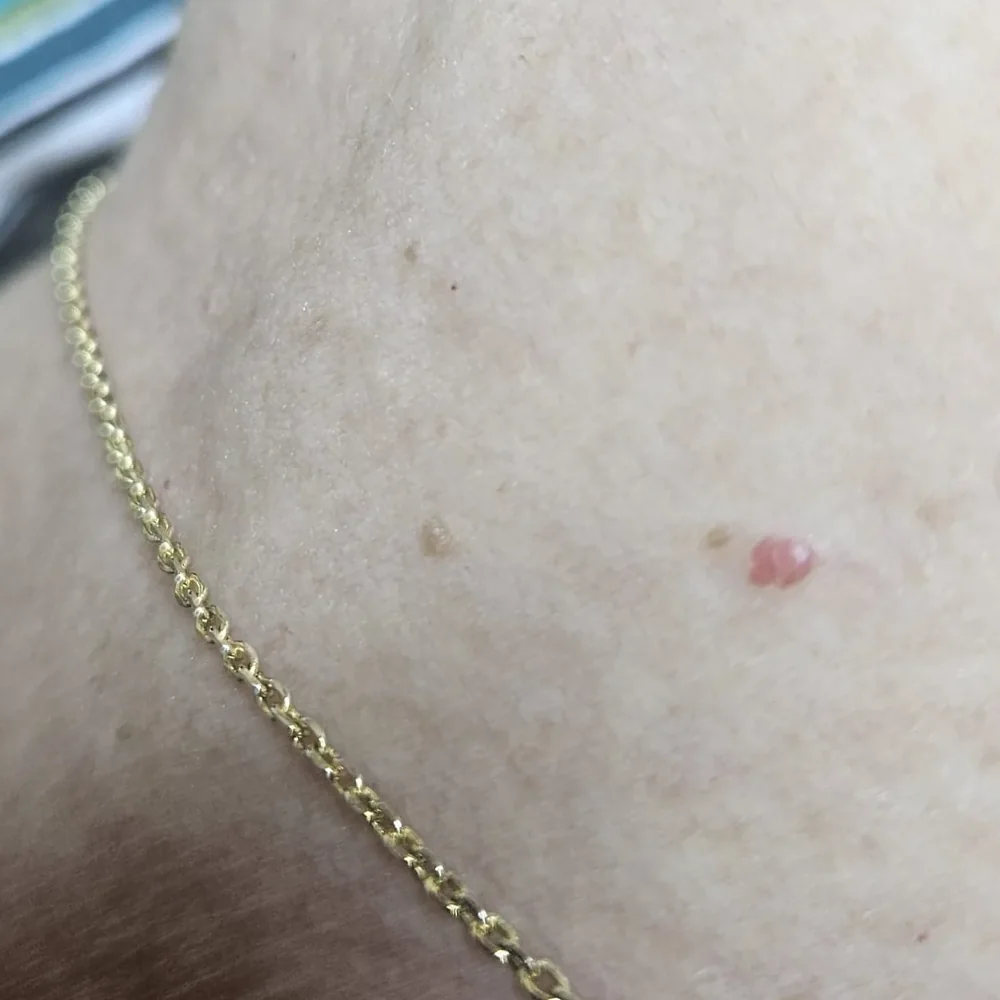
You noticed one a few years ago, a tiny bright red dot on your chest. Now there are a dozen, some flat, some slightly raised, and one of them bled when your shirt caught it.
Most of the time, that story has a boring ending. But “red dots on skin” covers a few very different things, and one of them is not something to read about online at all. So before anything else, the test that sorts them.
First, the glass test
Take a clear drinking glass and press its side firmly against the spots. Look through the glass.
- The spots fade or go pale under the pressure. That is what most harmless red marks do, including the cherry angiomas this article is mostly about. Keep reading.
- The spots stay clearly visible through the glass. They may be petechiae: pinpoint bleeds under the skin. Petechiae can come from straining, coughing or vomiting hard, but they also have causes that need a doctor, including problems with platelets, some medications and infections.
If a rash does not fade under the glass and you also have a fever, a headache, or feel unwell, that is an emergency. Call 911 or go to the emergency department. Do not wait to see how it looks tomorrow.
If you have non-fading spots without feeling ill, see your family doctor or a walk-in clinic soon, not a cosmetic clinic.
Cherry angiomas: the usual answer
The red dot that arrives in adulthood, stays for years and slowly gains company is most often a cherry angioma. In Spanish and several other languages they are called puntos rubí, ruby points, which is why you will see both names.
What they usually look like:
- Bright cherry red, sometimes darker purple-red as they age
- Smooth and round, from a pinpoint up to a few millimetres
- Flat at first, often becoming slightly domed
- On the trunk, arms, shoulders and stomach, less often the face and scalp
- More of them every year from your thirties or forties on
They are a small cluster of dilated capillaries, which explains the colour and why they bleed so dramatically when nicked. A razor, a bra strap or a fingernail can produce far more blood than seems reasonable for something that size.
We have written separately about why cherry angiomas suddenly multiply. The short version is age and genetics, with pregnancy and some other factors playing a part. They are generally considered harmless and are not something you caused.
The other usual suspects
Not every red dot is an angioma. The common look-alikes:
Spider angiomas. A central red dot with fine red lines radiating out like legs, often on the face, neck and upper chest. Press the centre and the whole thing blanches, then refills from the middle. A few are common, especially in pregnancy and in children. Many appearing in an adult is worth mentioning to your doctor, because they can be linked to liver conditions.
Keratosis pilaris. Rough, sandpapery little red or skin-coloured bumps on the backs of the upper arms, thighs or cheeks. Each one is a plugged hair follicle. Very common, harmless, and better handled with gentle exfoliating moisturisers than with any removal.
Folliculitis. Small red bumps, often with a white tip, centred on hairs. Usually from shaving, friction, sweat or hot tubs. These come and go rather than staying for years.
Bites and heat rash. Itchy, appear quickly, and fade over days. If your red dots itch and came in a batch overnight, this is a better bet than angiomas.
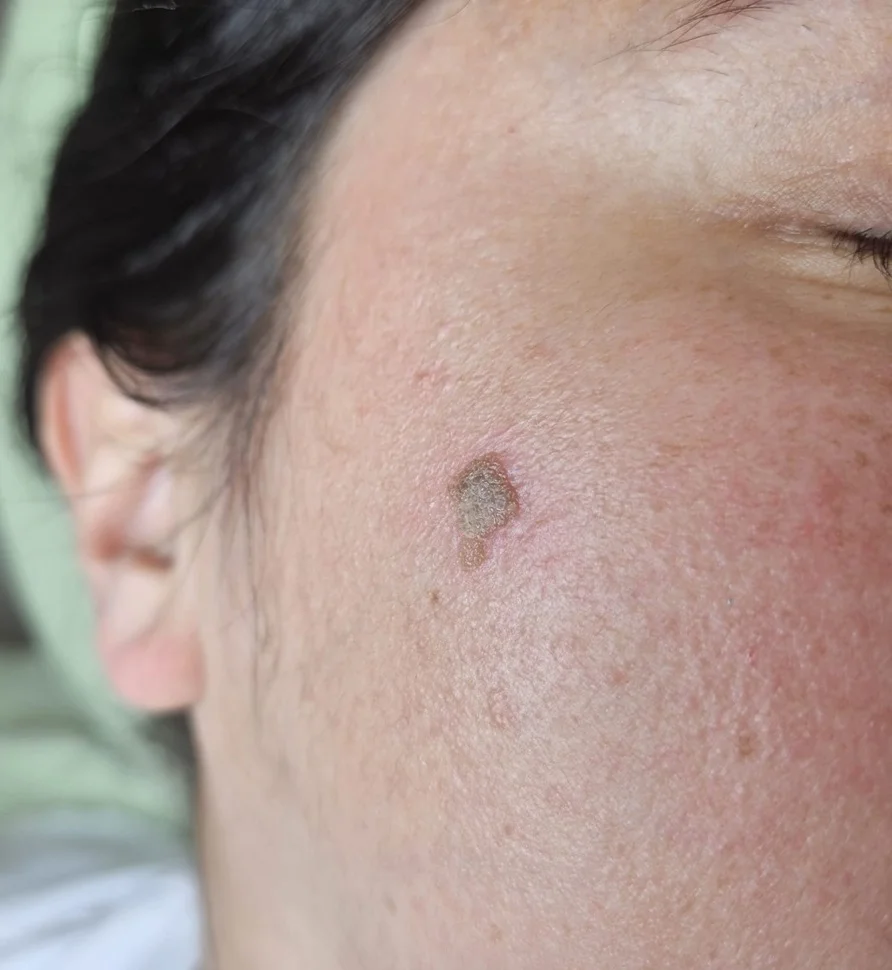
A single red bump that grows fast. A spot that appears and enlarges over weeks, looks moist or raw, and bleeds easily may be a pyogenic granuloma, a fast-growing vascular growth that a doctor should see. Rarely, a red bump that is new and changing can be something more serious. That is why “new, growing, bleeding on its own” is on the list below.
Vicaria does not diagnose skin conditions. Our practitioners are not licensed physicians or dermatologists in Ontario. This list is to help you know what questions to ask, not to tell you which one you have.
When a red spot belongs with a doctor first
Book with your family doctor or a dermatologist, not with us, when a red spot:
- Does not fade under the glass test
- Appeared suddenly alongside fever, bruising, nosebleeds or bleeding gums
- Is new and growing quickly, over weeks rather than years
- Bleeds on its own, without being scratched or caught
- Is changing in colour, shape or texture, or looks different from all your other spots
- Is painful, crusted or ulcerated
- Is one you are simply not sure about
None of those is something to settle with a photo or a webpage, ours included.
What can be removed, and how
Familiar, long-standing cherry angiomas that look like the rest of your cherry angiomas are the ones a cosmetic service exists for. People usually come in for one of three reasons: one keeps bleeding when it catches, there are now enough of them to bother you, or one sits somewhere visible.
At Vicaria we treat them with electrocautery: a fine probe delivers controlled heat to each spot. Most people describe it as a brief warm sting. A small spot often takes seconds, which is why a cluster of them is usually done in one visit. Each one forms a tiny scab that falls off over one to two weeks, and the mark underneath fades over the following weeks. Scarring and pigment change are possible, especially on darker skin, and we go through those risks before treatment. We explain exactly what electrocautery feels like and how skin heals afterwards in its own article.
Removal deals with the spots treated. Cherry angiomas are a tendency, so new ones can still appear over time.
Cost and booking in Hamilton
Vicaria’s ruby points (cherry angioma) treatment is at Unit 2B, 144 James St S, downtown Hamilton, serving Ancaster, Dundas, Stoney Creek, Waterdown, Burlington and Grimsby.
- A visit: $99, HST included, covering the in-person consultation and the first spot
- Each extra spot in the same visit: $20
- Never more than $299 a visit, however many spots, and the same price whatever the size
Three spots come to $139, five to $179, and from 11 spots it stays at $299. If you would rather know first whether your spots look like something we treat, send a photo.
Call (365) 336-9757 or message us on WhatsApp.
Important: red spots that do not fade when pressed, appeared suddenly, come with fever or feeling unwell, or are new, growing, bleeding on their own or changing should be assessed by a licensed physician or dermatologist before any cosmetic removal. A non-fading rash with fever is an emergency.
Services that fit this topic
Yamilet Pina and Maurin Casella are certified health coaches (IIN). This content is educational and does not replace medical advice. If you have a medical condition, please consult your healthcare provider.