Is It an Age Spot, a Mole, or a Seborrheic Keratosis? The 'Stuck On' Test
What causes seborrheic keratosis, why the growths look pasted onto the skin, how they differ from age spots and moles, and when a brown growth needs a doctor.
Somewhere on your body there is a brown thing you have been meaning to ask about.
You have not, because it does not hurt, and because you are not sure whether it is an age spot, a mole, or something that needs a doctor. So it has stayed on the list for three years.
Here is the test that sorts most of them out, and it takes about two seconds. It is also the first thing we ask about when someone calls us for seborrheic keratosis removal.
The ‘stuck on’ test
Touch it.
- An age spot (a solar lentigo) is flat pigment. You can see it. You cannot feel it. Your fingertip passes straight over.
- A mole grows out of the skin and blends into it. Its edges belong to the surrounding skin.
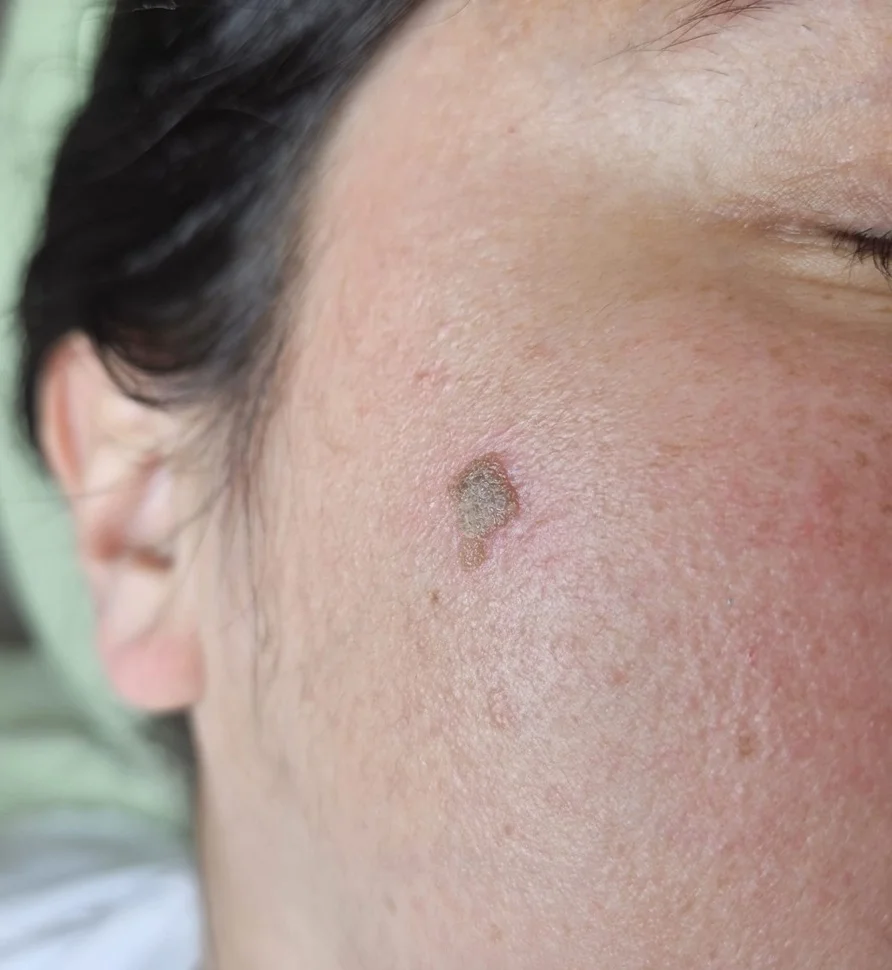
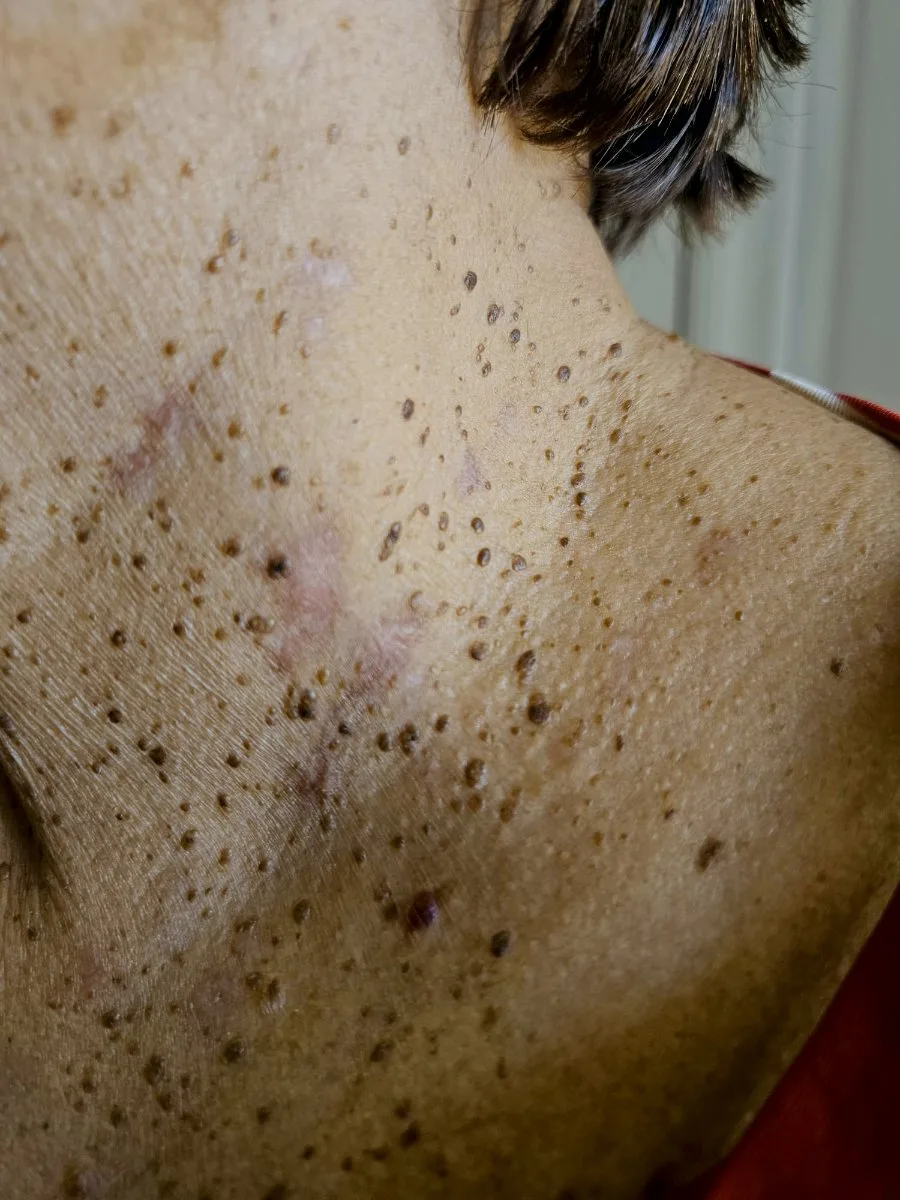
- A seborrheic keratosis is raised, waxy or rough, and looks and feels pasted onto the surface — as if you could pick at an edge and lift it.
That last quality is the classic descriptor for a reason. It is the single most useful thing you can assess yourself, and it is about texture rather than colour, which is where most people get stuck. Seborrheic keratoses come in tan, brown, black, greyish, and occasionally almost white. Colour is a poor guide. Feel is a good one.
They also tend to be stable. It has looked broadly the same for a year or more, growing slowly at most. Things that change quickly belong in a different conversation, which I will get to.
What they actually are
A seborrheic keratosis is a benign overgrowth of the outer layer of the skin. Nothing about it is infectious, nothing about it becomes cancer, and most people over fifty have at least a few.
What drives them:
- Age. Uncommon before forty, unremarkable after fifty, and the count generally rises with each decade.
- Genetics. The strongest factor after age, and often strikingly so — people frequently develop them in the same distribution a parent had.
- Friction and skin folds appear to matter for some locations.
What does not drive them, despite the assumption:
- Sun damage as the primary cause. This is where people conflate them with age spots. Age spots genuinely are sun-related. Seborrheic keratoses turn up on backs, under bra lines and on covered skin, which is hard to square with sun exposure.
- Hygiene, diet or “toxins”. No.
Where they show up
Most often the chest and back, the face — especially temples and hairline — the scalp, the shoulders, and along the bra line and under the breasts, where friction gets involved.
The scalp is the one people underestimate, because you cannot see it and you find it with a comb. That location has its own considerations, which we cover on the seborrheic keratosis service page.
The part where I stop being reassuring
Everything above is about a benign growth. Now the reason the whole category still gets treated with care.
Melanoma and other skin cancers can resemble a dark, irregular growth. A seborrheic keratosis does not become one — but a lesion you have assumed is a seborrheic keratosis for two years might not be. Those are different statements and the second one is the one that matters.
I spent two decades in medicine before this work, and I will be direct: a webpage cannot do this, and neither can a cosmetic consultation. Vicaria’s practitioners are not licensed physicians or dermatologists in Ontario and we do not diagnose skin conditions.
See a doctor first if a growth is:
- New, or newly noticed on skin you look at often
- Changing in size, shape or colour
- Uneven in colour, or has an irregular or blurred border
- Bleeding without being knocked, crusting or ulcerated
- Itchy or painful in a way your other spots are not
- Not like your other spots — that instinct is worth more than any checklist
The point of that list is not to alarm you. It is that having it looked at is a covered appointment with your family doctor, and it removes the uncertainty that has kept the thing on your list for three years.
Please don’t scrape it off
The “stuck on” quality creates a specific temptation, and people do act on it.
They are usually more firmly attached than they look. Scraping or filing produces bleeding, a wound in an awkward place, and a real chance of a scar worse than the growth. Home freeze pens and acid preparations burn the normal skin around the target — we wrote about what each product in that aisle actually does.
And the reason clinicians dislike home removal most: it destroys the lesion. If a growth ever needed assessing, you have removed the evidence.
What removal involves
For a familiar, stable growth in a suitable location, we use electrocautery — controlled heat applied to a small treatment area, which removes the growth and seals as it goes.
A typical appointment runs 15–30 minutes depending on how many. Most people describe a brief warm sensation per lesion. Afterwards the area may be pink or slightly crusted for a week or two, scabs come off on their own, and you leave with written aftercare. Healing and cosmetic results vary, and scarring, pigment change, bleeding and infection are possible.
The growths we treat are removed. If you are prone to them, new ones can appear elsewhere over time — that is the normal pattern rather than a failed treatment.
- Free 15-minute phone or WhatsApp consultation
- In-person consultation: $60 CAD + tax
- Treatment: from $20 CAD + tax per lesion, by size and location
Multiple growths in one region are usually addressed together, and the consultation fee is charged once. The full cost and OHIP guide is here.
Booking in Hamilton
Vicaria is at Unit 2B, 144 James St S in downtown Hamilton, serving Ancaster, Dundas, Stoney Creek, Waterdown, Burlington and Grimsby.
Start with the free 15-minute call and describe what you have — where, how long, whether it has changed. If anything in that description belongs with a physician, we will tell you so on that call, and that is a useful outcome rather than a wasted one.
Call (365) 336-9757 or message us on WhatsApp.
Important: any growth that is new, changing, unevenly coloured, irregularly bordered, bleeding on its own, or unlike your other spots should be assessed by a licensed physician or dermatologist before cosmetic removal.
Services that fit this topic
Frequently Asked Questions
What causes seborrheic keratosis?
Age and genetics are the strongest factors. They become common from the forties onward and they run strongly in families — people often have the same distribution their parent had. Unlike age spots, they are not primarily sun-damage lesions, which is why they turn up on skin that rarely sees daylight.
How do I tell a seborrheic keratosis from an age spot?
Feel it. An age spot, or solar lentigo, is flat pigment — you can see it and not feel it. A seborrheic keratosis is raised, waxy or rough, and your fingertip finds it easily. They also often appear stuck onto the surface rather than blended into it.
Can a seborrheic keratosis turn into cancer?
No, seborrheic keratoses are benign and do not become cancerous. The reason caution still matters is resemblance: melanoma and other lesions can look similar, particularly when dark and irregular. Vicaria does not diagnose skin conditions, so anything uncertain goes to a licensed physician or dermatologist first.
Are they contagious, and can they spread?
Not contagious. They do increase in number with age, but that is the same tendency producing more of them rather than one growth spreading to the next. You cannot pass them to a partner or pick them up from a pool.
Can I scrape or file one off?
Please don't. They can be surprisingly firmly attached, scraping causes bleeding and scarring, and it destroys the lesion a doctor might have wanted to look at. Home freezing and acid preparations have the same problem plus a burn risk on surrounding skin.
Do they grow back after removal?
The growths we treat are removed during the session. If you are prone to them, new ones can still form elsewhere over time — that is the usual pattern and we say so before treatment rather than after.
Yamilet Pina and Maurin Casella are certified health coaches (IIN). This content is educational and does not replace medical advice. If you have a medical condition, please consult your healthcare provider.